

Precision shooting is often discussed in terms of equipment, ballistics, and the final score on the board. Yet, behind every high-performance firearm and every Olympic medal lies a complex, often overlooked infrastructure of people, history, and policy. As we look at the sport today, it becomes clear that its most enduring advancements are not merely technological, but structural and human. Whether examining the rapid industrial scaling of the 1940s or the evolving governance of international competition, the story of shooting sport is a story of how people organize themselves to achieve excellence.
The Industrial Legacy of Human Systems
To understand the current state of the industry, one must look at the foundations built during times of intense pressure. The Springfield Armory’s Building 104, erected in 1940, serves as a primary case study in how human systems scale to meet national needs. According to the National Park Service, the facility was designed, engineered, and erected in just three months following the fall of France. This was not simply a construction project; it was a mobilization of human skill. By 1941, production of the M1 Garand rifle surged from 200 units per eight-hour day to 1,000 units, eventually reaching 1,100 by December 1941 (https://home.nps.gov/spar/learn/historyculture/federal-square.htm).
However, the numbers only tell part of the story. The true engine of Building 104 was the workforce, including individuals like Terry Courchesne, who operated milling machines, and Walter Moczarski, a set-up man who managed teams of women to ensure machines were tuned and cutters were sharp. The facility was a testament to the fact that precision production is a collaborative effort. As noted in The story behind the steel, understanding this manufacturing history requires looking beyond the model names to the people who kept the lines running. The legacy of this era—which included pioneering digital computer-programmed machining—continues to influence modern manufacturing, including the CNC processes used by companies today.
Governance and the Athlete’s Voice
While the industrial side of the sport focuses on manufacturing precision, the sporting side focuses on human performance and organizational fairness. The evolution of the International Shooting Sport Federation (ISSF) illustrates a transition from top-down administration to a more athlete-centered model. In 2015, Abhinav Bindra and Danka Bartekova emphasized the importance of keeping the Athletes Committee at the heart of decision-making. At that time, the committee was tackling the implementation of the IOC Agenda 2020, which sought to balance tradition with evolution, particularly regarding gender equality (https://www.issf-sports.org/news/2457). This shift toward including athletes in the policy-making process was a recognition that those on the field of play have unique insights into the sport’s future.
This collaborative spirit extends to how the ISSF manages its international relationships. ISSF Ambassador Walter Borghino has worked to bridge the gap between civilian and military sport organizations. By formalizing a convention of collaboration with the International Military Sports Council (CISM), Borghino has helped streamline sports calendars and share knowledge across different sectors. As Borghino noted, the goal is to provide a counterpart for organizers who previously struggled to connect with national federations (https://www.issf-sports.org/news/4704). This administrative work, often invisible to the spectator, is the framework that allows global competition to function smoothly. Understanding this process is key to moving From announcement to reported story, as it highlights the continuous work required to maintain international cooperation.
Inclusion as a Structural Pillar
Modern shooting sport is increasingly defining its future through the lens of inclusion. Melis Giraud, an ISSF Executive Committee member, argues that inclusion is not merely about numbers but about legitimacy and voice. For Giraud, true inclusion means that women are not only present as athletes but are also positioned as decision-makers at the table. She emphasizes that structural measures—such as equal medal events and transparent certification pathways for referees and coaches—are what make equality sustainable (https://www.issf-sports.org/news/4947).
This perspective is shared by athletes like Fernanda Russo, who has seen the evolution of opportunities firsthand. Russo highlights the expansion of mixed team events as a significant step, noting that such formats reinforce the reality that men and women contribute to performance at the same level. For the next generation, seeing women in leadership roles as technical officials and federation leaders is essential. It signals that a career in shooting sport does not end when one steps off the firing line; it can evolve into a lifetime of governance and influence (https://www.issf-sports.org/news/4948). Whether through the industrial grit of the 1940s or the committee rooms of 2026, the sport’s resilience remains tied to these human systems. By prioritizing transparency, athlete input, and structural equality, the shooting community ensures that the infrastructure supporting the sport is as precise as the equipment used within it.
Primary sources
- ISSF - Interview with ISSF Ambassador Walter Borghino
- ISSF - "Keeping Athletes Committee at the heart of ISSF decision-making."
- Building 104 (Federal Square) - Springfield Armory National Historic Site
- ISSF - International Women's Day series: Melis Giraud
- ISSF - International Women’s Day series: Fernanda Russo
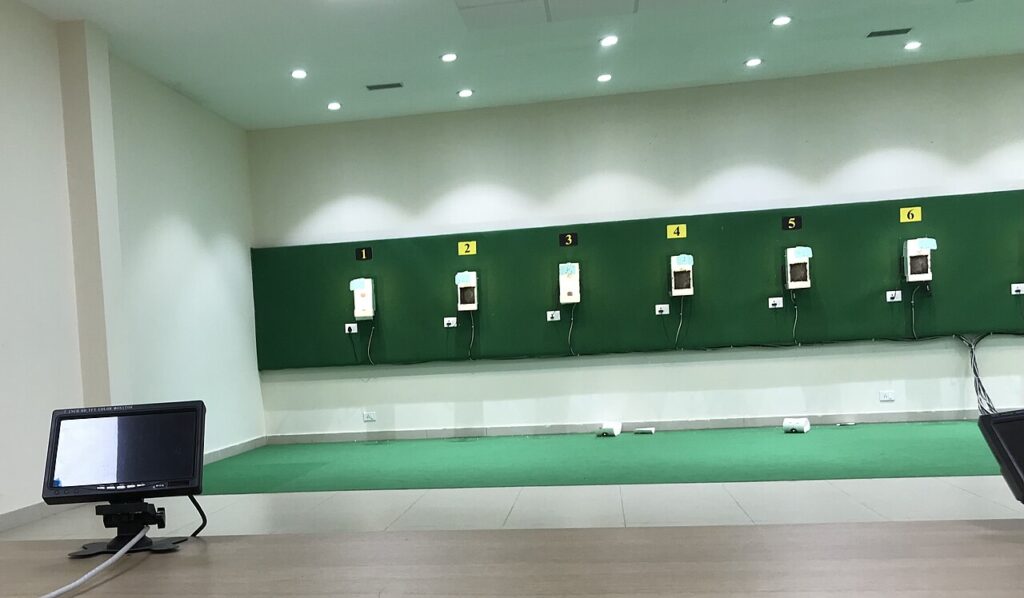
Representative photo: An indoor shooting range facility, illustrating the specialized infrastructure required to support precision sport and athlete training. Photo: Subhrasingh / Wikimedia Commons · CC BY-SA 4.0. Resized for display. Sources checked October 23, 2026.

Sources & further reading
- ISSF - Interview with ISSF Ambassador Walter Borghino ↗
- ISSF - "Keeping Athletes Committee at the heart of ISSF decision-making." ↗
- Building 104 (Federal Square) - Springfield Armory National Historic Site ↗
- ISSF - International Women's Day series: Melis Giraud ↗
- ISSF - International Women’s Day series: Fernanda Russo ↗
Sources reviewed 2026-10-23.
Prepared for Gunfire Magazine with AI assistance from the linked source material and the publication’s editorial brief. This piece does not claim original interviews, on-site reporting or hands-on product testing.