

The Artifact as a Historical Document
When visitors enter institutions such as the Cody Firearms Museum, they are often immediately struck by the sheer volume of the collection. With thousands of firearms and related artifacts in its holdings, the museum serves as a repository for far more than just mechanical devices. As noted in the Cody Firearms Museum collections overview, these objects chronicle technological development from the earliest incarnations to modern forms. For the historian or the curious observer, the value of these items lies in their provenance—the documented history of an object's origin, ownership, and use. In a museum setting, these items are treated strictly as artifacts rather than weapons. Their purpose is education, and they are preserved in perpetuity to ensure that future generations can study the evolution of craftsmanship and industrial design. As explored in our earlier feature, Cody Firearms Museum: Reading a Collection Beyond Model Names, moving beyond the model name allows a visitor to understand the broader narrative of human endeavor.
Industrial Evolution at Springfield Armory
Provenance is not merely about tracking the ownership of a single rifle; it is about understanding the industrial context that made that rifle possible. Springfield Armory began its federal manufacturing role in 1794; today, Springfield Armory National Historic Site preserves the story of that industrial transition. According to the Springfield Armory National Historic Site site data, the facility was a leader in the development of interchangeability and the mechanization of precision manufacturing. This shift from hand-crafted production to mass manufacturing did more than just increase output; it changed the landscape of the local community and the nature of the American workforce. By examining the records of the Armory, researchers can see how the facility evolved from a modest operation employing a few hundred workers to a massive industrial hub that, by World War II, employed over 14,000 people. This human element is essential to the story, as detailed in our analysis, The People Behind the Production Totals.
The Designer and the Archive
The connection between an object and its creator is often solidified through archival records. John Garand, the inventor of the legendary M1 rifle, serves as a primary example of how an individual's career path can be traced through museum documentation. Biographical records from the Springfield Armory National Historic Site on John Garand describe his early working life as a bobbin boy in a textile mill and the later engineering career that brought him to the government's Springfield Armory. These records place Garand’s invention in the context of his working life and career. The archive preserves not just the finished product, but the iterative process of invention. By examining experimental models, such as the T1E1 or the M1E5, researchers can see the evolution of technology from a prototype to a standardized tool. As listed in the M1 Rifle variations and experimental models documentation, these pieces demonstrate the adaptability of Garand's design, moving from a shortened carbine intended for paratroopers to the M1D sniper variant used in Korea and Vietnam.
The Museum as a Living Archive
Modern museums have evolved to become more than just static display cases. The Cody Firearms Museum exhibits now feature interactive spaces and oral history archives that allow veterans and service members to record their own stories. This creates a bridge between the physical object and the lived experience. When a museum preserves a rifle, it is preserving a piece of history that was held, used, and maintained by individuals. The "Room of Reflection" at the Cody facility, for example, is dedicated to these voices, ensuring that the human perspective is never lost behind the technical specifications of the firearms. For the researcher or enthusiast, the takeaway is clear: provenance is the key to unlocking the full story. Whether one is reviewing factory ledgers, serial number logs, or oral history transcripts, the goal is to look past the surface of the object. By utilizing these primary sources, we can move beyond the myths and romanticized versions of history to understand the authentic, often complex, reality of the people who designed, built, and carried these tools throughout history.
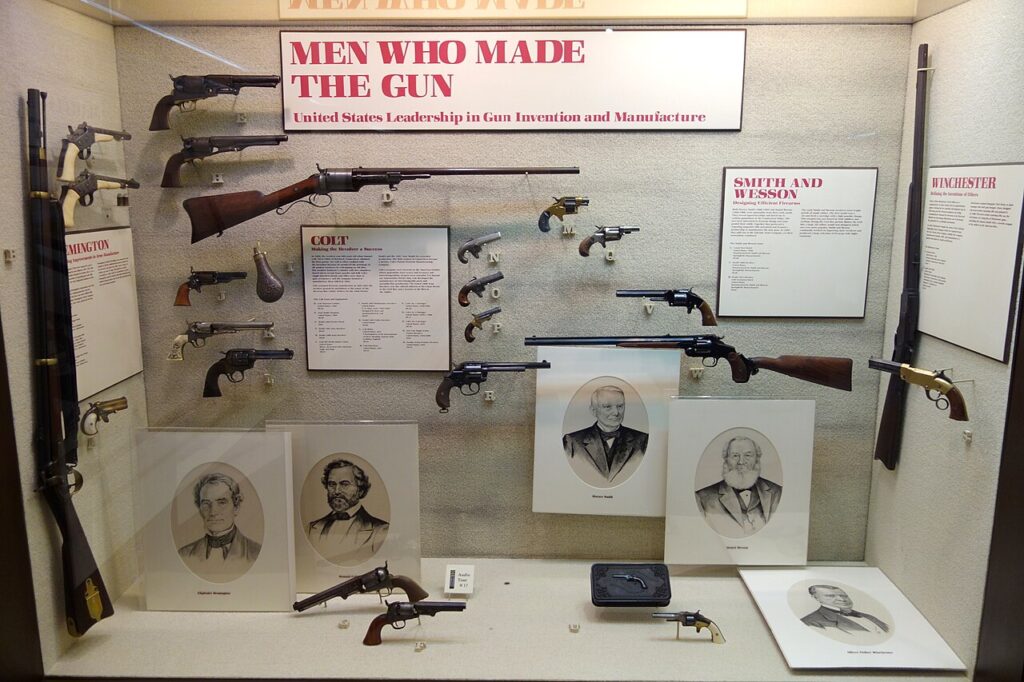
Representative photo. This museum display highlights the connection between inventors and their manufactured artifacts, illustrating the historical context essential to provenance. Photo: Daderot / Wikimedia Commons · CC0. Resized for display. Sources checked October 23, 2026.

Sources & further reading
- Collections - Cody Firearms Museum ↗
- Springfield Armory National Historic Site ↗
- John Garand - Springfield Armory National Historic Site ↗
- M1 Rifle variations and experimental models - Springfield Armory National Historic Site ↗
- Exhibits - Cody Firearms Museums ↗
Sources reviewed 2026-10-23.
Prepared for Gunfire Magazine with AI assistance from the linked source material and the publication’s editorial brief. This piece does not claim original interviews, on-site reporting or hands-on product testing.