

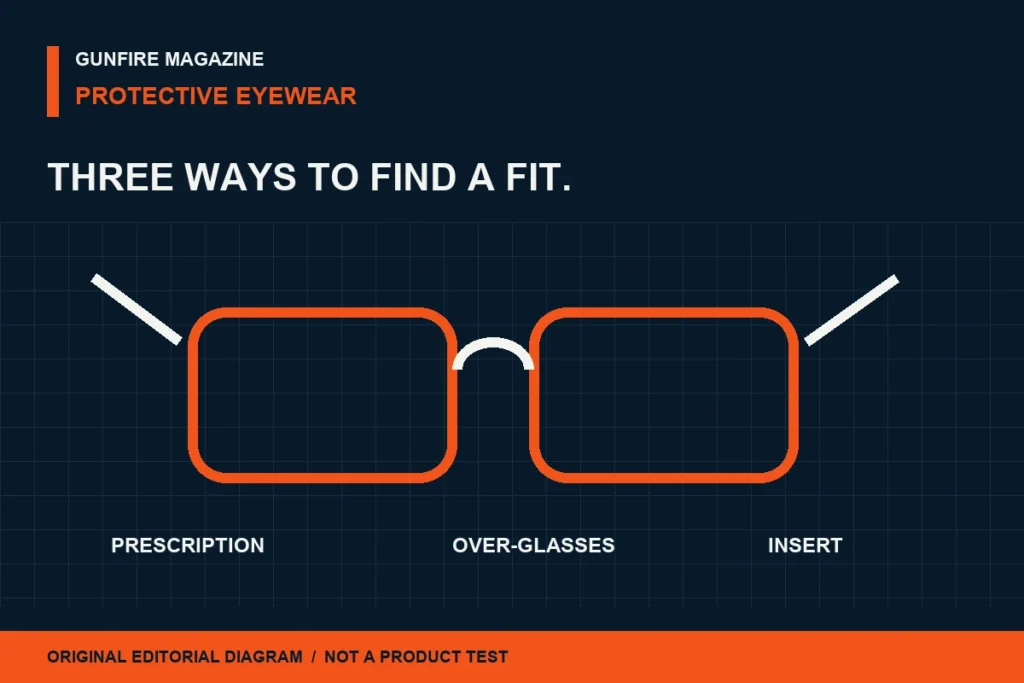
A prescription adds a second fit requirement to protective eyewear: the correction must stay properly positioned while the protective design does its job. Begin the buying conversation with that combined requirement.
Research-based buying guide: This article compares selection routes, not tested products. OSHA’s U.S. workplace eye-protection rule is the cited reference for hazard-appropriate protection and prescription compatibility. It is not a certification of a recreational product or a substitute for the requirements of your range.
Three routes to discuss with a qualified provider
| Route | What to confirm | Budget and maintenance question |
|---|---|---|
| Integrated prescription protection | The complete frame-and-lens configuration meets the stated protection requirement with your prescription. | What changes when your prescription is updated? |
| Over-glasses protection | The protective design fits over your everyday glasses without displacing either pair. | Will your next everyday frame still fit? |
| Prescription insert system | The insert is authorized for the exact protective frame and lens configuration. | Which parts must be replaced together? |
Keep the complete configuration in view
OSHA’s rule addresses protection suitable for the hazard, side protection where flying objects are a hazard, and prescription protection that does not disturb proper lens position. It also identifies criteria for protective devices. Those distinctions offer useful questions for a shopping checklist.
Ask the provider to identify the exact frame, lenses, insert where applicable, claimed standard and supporting documentation. A statement attached to one lens option should not automatically migrate to a different prescription or replacement configuration. Keep that documentation with the purchase record.
Make compatibility part of the fitting appointment
Explain which hearing protection and other required equipment you will wear. Ask for a fitting check of the complete arrangement using the manufacturers’ instructions. If an over-glasses design presses your prescription frame out of position, that conflict needs to be resolved before use.
Ordinary vision correction and protective performance are separate requirements. An optician or qualified protective-equipment provider can help identify a prescription route that meets the relevant need. A retailer’s general label does not settle how a particular configuration fits you.
Compare the cost over time
A meaningful quotation includes the protective frame, prescription components, required accessories, fitting service and replacement arrangements. Ask whether a prescription update requires new lenses, a new insert or a complete system. Record return restrictions for custom-made components before ordering.
Check the approved cleaning method, replacement availability and inspection instructions. A low initial price offers limited value if the required components cannot be obtained later. Warranty terms should identify which pieces are covered and what the provider will do when a component needs attention.
Use a short purchase record
Save the model identifiers, prescription configuration, stated protection documentation, fitting date and provider contact. Before use, follow the manufacturer’s inspection instructions and the range’s rules. This record makes replacements less ambiguous and gives future comparisons a reliable starting point.
This guide does not recommend a lens tint, assign a safety rating or claim that Gunfire tested an eyewear system. Read our eyewear evidence guide and equipment compatibility feature for related questions.
Prepared for Gunfire Magazine with AI assistance from the linked source material and the publication’s editorial brief. This piece does not claim original interviews, on-site reporting or hands-on product testing.