

The Archive as Human Infrastructure
When researchers and enthusiasts approach the history of American manufacturing, it is easy to focus exclusively on the hardware—the serial numbers, the production dates, and the mechanical innovations. However, as documented in the records preserved by the Springfield Armory National Historic Site, the true story of the "American System of Manufacture" is found in the people who operated the machinery. The Springfield Armory, which functioned as a national hub for innovation from 1794 until its closure in 1968, serves as a primary case study for how industrial archives can be read beyond simple production statistics. As noted in the site's People of Springfield Armory overview, the Armory acted as a magnet for engineers and workers, creating a unique labor environment that shifted with the nation's wartime needs. This history is not merely a chronicle of rifles and muskets; it is a human history of adaptation, where workers were trained during times of conflict and released into the private sector during times of peace, carrying with them the high-technology skills that helped launch the Industrial Revolution.
Understanding this workforce requires looking past the cold, hard numbers of output. In our internal analysis, The People Behind the Production Totals, we explore how the diversification of labor, particularly during the World Wars, fundamentally altered the capacity of the facility. The National Park Service (NPS) archives effectively serve as a repository for this evolution, documenting not just the tools, but the individuals who wielded them. For the modern researcher, the value of these records lies in their ability to provide context to the technical manuals that often omit the human element. By linking the official production records with the stories of the workforce, we gain a more nuanced understanding of how American industrial capacity was built and maintained over nearly two centuries.
Connecting Contemporary Sport to Industrial Roots
The methodology of preserving human history is not limited to the industrial past; it is a living practice in modern shooting sports. The news archives maintained by organizations such as USA Shooting provide a contemporary parallel to the historical records of the Armory. By reviewing the USA Shooting news feed, one can see how the organization documents the development of athletes, the results of selection matches, and the governance of the sport. These news items serve as a modern oral history—a collection of moments that, when viewed in aggregate, tell the story of the sport's evolution in the 21st century. Just as the NPS records preserve the career of John Garand or the contributions of the Women Ordnance Workers, these modern archives preserve the career trajectories of athletes like Liana Amaris Cerra or the competitive outcomes of the 2026 Fall Selection Matches.
This connection between the past and the present is vital for maintaining an accurate historical record. When we read the reports of a 2026 World Championship result, we are reading the primary source material for future historians. The challenge for the researcher today is to apply the same rigor to these digital archives as one would to the physical records of the Springfield Armory. This involves verifying dates, understanding the context of the competition, and recognizing the limitations of the reporting. Whether investigating the history of the Blanchard Lathe or the current governance structure of an Olympic sport, the key is to look for the intersection of human effort and institutional output.
Methodology: Reading the Industrial Record
For those interested in conducting their own research, it is important to understand the scope and limitations of current archival access. The National Park Service notes that while the Springfield Armory archives are extensive, they require appointments for access, as limited staff and space dictate the capacity to assist researchers. Furthermore, the archive is not merely a repository for firearms; it encompasses architectural elements, fine art, and archaeological materials that document the site's evolution. When approaching this collection, researchers should treat the material as a multi-layered resource. The process of translating technical data into personal narratives is a skill that requires both patience and a commitment to primary sources.
In our review, Terry Courchesne’s Story Brings a Factory Back to Human Scale, we examine how firsthand accounts provide the context that technical manuals omit. Courchesne’s reflections offer a bridge between the cold, hard numbers of the M1 Garand production lines and the reality of the laborers who kept the facility running during pivotal decades. This type of analysis is essential for any researcher who wishes to move beyond the surface level of industrial history. By pairing these personal accounts with the official records, historians can reconstruct a more complete picture of industrial life. Whether you are investigating the history of the Watershops or the daily operations of Building 104, the key is to look for the intersection of human effort and mechanical output. Ultimately, the archive is not a static collection of objects; it is a dynamic record of human ingenuity, and it requires an active, inquisitive reader to bring that history to life.
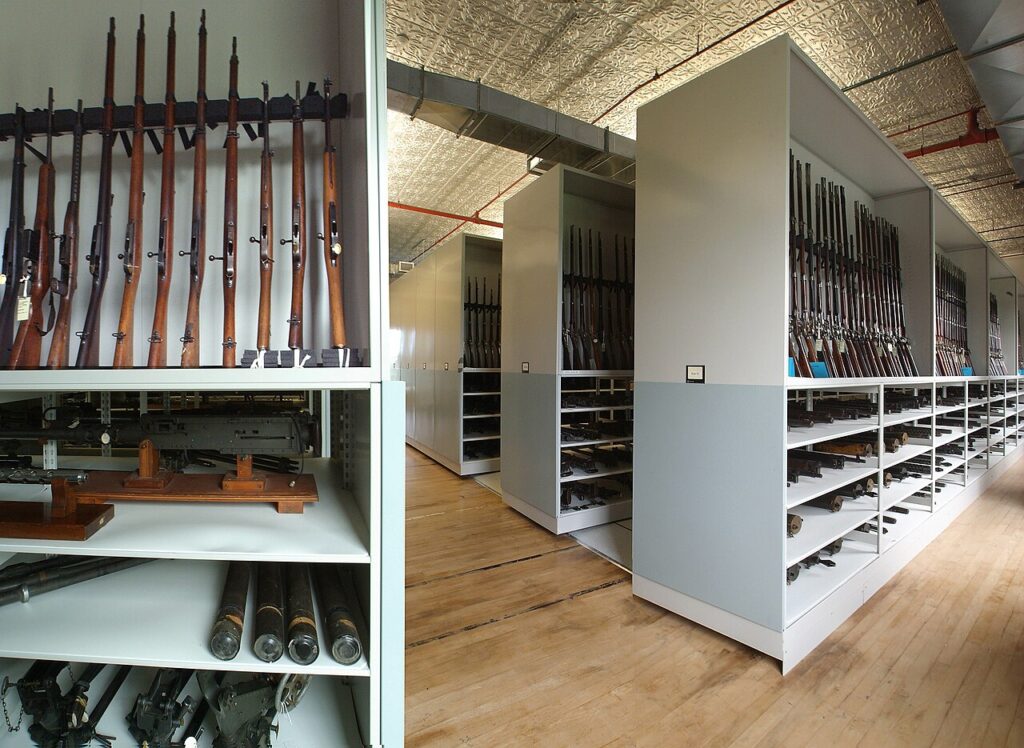
Representative photo: The Springfield Armory archives preserve not just the technical history of manufacturing, but the tangible artifacts that document the site's industrial evolution. Photo: NPS Photo / Wikimedia Commons · Public domain. Resized for display. Sources checked October 24, 2026.

Sources & further reading
Sources reviewed 2026-10-24.
Prepared for Gunfire Magazine with AI assistance from the linked source material and the publication’s editorial brief. This piece does not claim original interviews, on-site reporting or hands-on product testing.