

RESEARCH-BASED PRODUCT FEATURE
Based on published manufacturer specifications. Gunfire Magazine has not physically tested this product for this article.
The Anatomy of Informed Research
The process of selecting a new shotgun—whether for hunting, clay sports, or general collection—requires a systematic approach to research. Before a potential owner ever handles a firearm at a retail location, the administrative work of evaluating specifications is essential. Understanding the difference between a manufacturer's marketing language and the technical realities of a firearm's design is a critical skill for the modern enthusiast. Just as understanding the history of a piece can change your perspective, as discussed in Beyond the Display: How Provenance Reveals History, analyzing the mechanical lineage of a shotgun provides context for its intended use and reliability.
When you begin your research, you are essentially conducting an audit of engineering choices. Manufacturers often categorize their offerings by action type—such as semi-automatic, over/under, or pump-action—which serves as the first filter in your decision-making process. For instance, Browning notes that their current lineup, which includes everything from over/under designs to semi-automatics, is built on more than a century of innovation, spanning various gauges and intended uses (Source: https://www.browning.com/products/firearms/shotguns.html). Your goal is to look past the model name and examine the specific mechanical systems that define that platform.
Analyzing Mechanical Action Types
The mechanical action of a shotgun dictates not only how it operates but also how it handles recoil and cycles different types of ammunition. When reviewing specifications, look for clear explanations of how the action functions. For example, some autoloading systems, such as the Kinematic Drive found in certain semi-automatic platforms, are designed to cycle a wide range of loads, which is a significant factor for those who participate in diverse shooting activities (Source: https://www.browning.com/products/firearms/shotguns/a5/a5-camo.html). Other designs, like the over/under, utilize a full-width hinge pin and tapered locking lug system, which emphasizes different engineering priorities, such as lock-up strength and profile.
As you read through technical descriptions, ask yourself how these systems translate to your specific needs. Are you looking for the reliability of a recoil-operated system, or the specific balance and handling characteristics of a hinged design? It is helpful to remember that a product overview is only as useful as the information it provides, as noted in A Product Overview Is Useful—When It Says What It Is. Always prioritize specifications that detail the internal mechanics over general descriptive language.
Ergonomic Logistics and Adjustability
Modern shotguns have moved toward greater user-level adjustability, a trend that simplifies the process of achieving a proper fit. When reviewing a spec sheet, look for mentions of shim-adjustable stocks, which allow for modifications to the length of pull, cast, and drop. These features are not merely convenience items; they are essential for ensuring that the firearm aligns with the user's physical dimensions. A shotgun that cannot be adjusted to the shooter may result in inconsistent point-of-impact and increased felt recoil.
Furthermore, look for information regarding the recoil pad and stock material. High-quality synthetic stocks often include textured gripping surfaces, which are vital for maintaining control in various weather conditions. When you see a specification list that includes details about stock spacers or shim kits, it indicates that the manufacturer has designed the firearm with the user's interface in mind. This level of detail in the documentation is a positive indicator that the manufacturer has considered the long-term usability of the platform.
Understanding System Versatility
The final pillar of your shotgun research protocol should be versatility, specifically regarding the barrel dynamics and choke systems. The ability to swap choke tubes, such as the Invector-DS system, allows a single shotgun to perform a wide variety of tasks, from hunting waterfowl to shooting clays. When researching, verify the compatibility of the choke system with the ammunition you intend to use, particularly regarding steel shot performance.
Additionally, pay attention to barrel features like lengthened forcing cones and back-bored technology. These are designed to optimize pattern performance and reduce recoil, but they should be evaluated based on the manufacturer's specific technical claims. By focusing your research on these concrete mechanical and ergonomic features, you can develop a clear understanding of what a firearm offers before you ever step into a shop. This audit-based approach ensures that your final selection is driven by data and compatibility rather than superficial marketing.
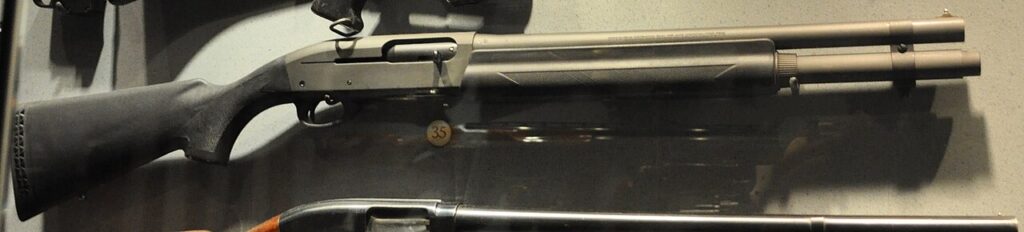
Representative photo showing a modern semi-automatic shotgun, the type of firearm typically evaluated during the research process described in the article. Photo: Darkhelmet322 at English Wikipedia / Wikimedia Commons · CC BY-SA 3.0. Resized for display. Sources checked October 24, 2026.

Sources & further reading
- Shotguns - Semi-Auto • Over/Under • Pump-Action - Browning ↗
- A5 Camo - Semi-Auto Shotgun - Browning ↗
Sources reviewed 2026-10-24.
Prepared for Gunfire Magazine with AI assistance from the linked source material and the publication’s editorial brief. Specifications and manufacturer claims are attributed to their original sources.